
What Is Vibe Coding? A Practical Guide for Founders (and What Happens in Production)
TL;DR
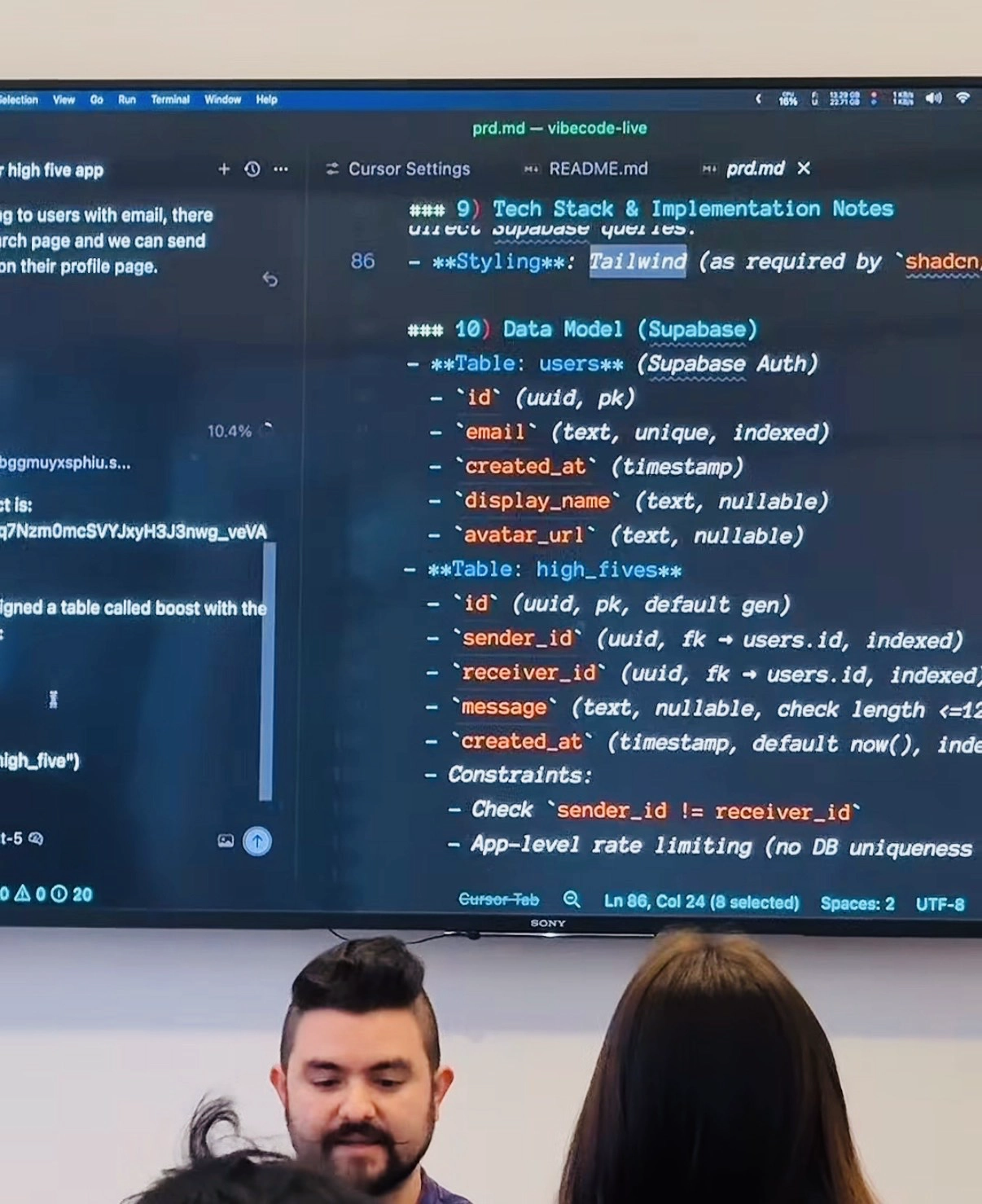
Vibe coding is building software by describing what you want in plain language and letting an AI write the code, often without reading or fully understanding what it produces. You prompt, the tool generates, you check whether the result feels right, and you iterate on the vibes. It’s fast, it’s genuinely useful for prototypes, and it changes what “I built an app” can mean for someone who’s never opened a code editor.If you’re a founder who spun up a working app over a weekend with a tool like Lovable or Replit, this guide is for you. We’ll cover where the term came from, how the practice actually works, which tools people use, and the honest part most breathless takes skip: what happens when a vibe-coded prototype meets real users, real data, and real attackers.



What does vibe coding mean?
The term was coined by Andrej Karpathy — OpenAI co-founder and former Tesla AI director — in a post on February 2, 2025. His exact words: "There's a new kind of coding I call 'vibe coding', where you fully give in to the vibes, embrace exponentials, and forget that the code even exists." That last clause is the whole idea. You're not reading the code line by line and reasoning about it. You're steering an AI by feel and trusting the output.
Worth being precise: Karpathy coined the term, not the practice of AI-assisted coding, which existed for years before he named it. The label stuck because it captured something new about the attitude: deliberately not caring how the code works.
The idea moved from niche to mainstream fast. Merriam-Webster now recognizes "vibe coding," describing it as writing code in a somewhat careless fashion with AI assistance. And Collins Dictionary named it Word of the Year 2025, announced November 6, 2025, defining it as "the use of artificial intelligence prompted by natural language to write computer code." When two major dictionaries pick up a term inside a year, it's arrived. But a Word of the Year is a cultural signal, not proof the code it produces is any good.
How vibe coding works, and how to start
The mechanics are simpler than the hype suggests. You open an AI coding tool, describe the app or feature you want in normal sentences, and the tool generates working code, sometimes a whole running application. You look at the result, describe what's wrong, and it revises. The loop is prompt, generate, run, react, repeat.
If you want to try it, here's a sane way to start:
- Pick one small, real thing to build. A landing page with a signup form, an internal tool, a simple CRUD app. Scope beats ambition on your first run.
- Choose a prompt-to-app tool (see the next section) and describe your idea in plain language: what it does, who uses it, what each screen needs.
- Iterate in small steps. Change one thing per prompt. Big vague prompts produce big vague messes that are hard to untangle.
- Test it like a user. Click everything. Try to break it. Note what fails.
- Know what you're looking at. You don't need to read every line, but knowing roughly what the tool built (where data lives, what's exposed) is the difference between a demo and something you can safely put in front of people.
The mindset that separates a usable result from a fragile one is treating the AI as a fast junior developer you still have to direct, not an oracle. Taking "forget the code exists" literally is where founders get burned.
The best vibe coding tools
There's no single "best" tool. The right one depends on whether you're a non-technical founder wanting a finished app or a developer wanting AI inside a real workflow. Here's the honest landscape as of 2026.
ToolWhat it isBest forLovablePrompt-to-app builder generating full-stack web apps (front end plus a Supabase backend) from plain descriptionsNon-developers building MVPs without writing codeReplit (with its AI Agent)Browser-based platform combining editor, hosting, and deployment; the AI Agent builds and deploys apps from promptsBeginners and prototypes, no local setupBolt.new (StackBlitz)Browser-based AI app builder that spins up full-stack apps from a prompt and runs them in-browserFast full-stack prototypes you can share instantlyv0 (Vercel)AI focused on generating UI/front-end code (React with Tailwind/shadcn) from text or imagesFront-end and UI generation specificallyCursor (Anysphere)AI-first code editor (a VS Code fork) with in-editor chat, multi-file edits, and an autonomous agent modeDevelopers who want AI woven into a full IDEGitHub Copilot (GitHub/Microsoft)The original mainstream AI pair-programmer, with inline autocomplete and chat inside editors; launched 2021Developers wanting AI completion in their editorClaude Code (Anthropic)Terminal-based agentic tool that works across a whole codebase, reading, editing, and running commandsDevelopers wanting an autonomous agent in their environment
So, is Lovable, Cursor, or Claude "vibe coding"? All three are AI coding tools, but they sit at different points. When most founders say "vibe coding," they mean the prompt-to-app end — Lovable, Bolt.new, Replit's Agent, v0 — where you never really touch code. Cursor, Copilot, and Claude Code can absolutely be used that way, but they're built to keep a developer in the loop, which is a different game. For a fuller take on whether these tools can turn you into an app developer, see our piece on whether vibe coding can really make you an app developer.
Is vibe coding bad? Does it actually work?
Vibe coding works well for what it's built for: prototypes, MVPs, internal tools, and proving an idea fast. It works poorly as a substitute for engineering when an app needs to be secure, reliable, and maintainable at scale. Both halves of that sentence are true at once, and the trouble starts when founders hear only the first half.
On the "it works" side, getting from idea to a clickable, testable product in hours instead of weeks is real and valuable. Speed lets you learn what to build before you overinvest.
On the "be careful" side, the research is sobering. In a controlled Stanford study (Perry, Srivastava, Kumar, and Boneh, presented at ACM CCS 2023, with 47 participants), developers using an AI assistant wrote less secure code than those without one, yet were more likely to believe their code was secure. That overconfidence gap is the dangerous part, and the takeaway holds regardless: AI writes plausible code that often isn't safe.
Maintainability is the other quiet cost. Google's DORA program, one of the largest ongoing studies of how software actually gets shipped, has found that rising AI adoption is associated with a measurable drop in delivery stability, even when it speeds individual work up. For a vibe-coded MVP, that tradeoff shows up later as an app that's harder to change and easier to break. None of this makes vibe coding "bad." It makes it a starting line, not a finish line.
Is vibe coding the future?
In the sense that describing software in natural language and having AI generate it is becoming a normal part of how software gets made — yes, that direction looks durable, and the dictionaries catching up reflect it. But "the future of building prototypes" isn't the same as "the future of shipping production systems." The likelier future is a split: AI handles more of the first draft, and skilled people handle architecture, security, and the hard parts of scale. The teams that win won't be the ones who vibe code the most. They'll be the ones who know when to stop vibing and start engineering.
When to bring in professionals
A good rule of thumb: keep vibe coding while you're learning and validating, and bring in engineers before real users, real money, or real data are on the line. The signals that it's time include handling personal or payment data, onboarding paying customers, an app that's getting slow or flaky, or code you can no longer safely change. Knowing when to bring in engineers is a bit like knowing when a trail turns into real mountaineering — the fun part got you this far, but the next stretch rewards a guide who's done it before.
Before you build much at all, it helps to be sure you're building the right thing, which is what our guide to validating your app idea covers. Once something's built, the next question is whether it's actually ready for real users — we break that down in our guide to production-readiness for AI-generated code.
This is exactly the handoff 303 Software was built for. We're a Denver custom software firm that's been shipping production software since 2006, and our Vibe Check service exists to take a promising, half-baked AI-built app and turn it into something secure, scalable, and ready for real customers, without throwing away the momentum you already have.
Frequently asked questions
What does vibe coding mean?
Vibe coding means building software by describing what you want in natural language and letting an AI generate the code, often without reading or fully understanding it. The term was coined by Andrej Karpathy on February 2, 2025.
Is vibe coding bad?
No, it's a tool with a right use. It's excellent for prototypes, MVPs, and internal tools, and risky when used as-is for production, because AI-generated code often has security and maintainability problems. The mistake is shipping a prototype as if it were finished software.
Does vibe coding actually work?
Yes, for getting from idea to a working, testable app quickly. It works less well as a replacement for engineering when an app needs to be secure, reliable, and maintainable at scale. That stage still needs human expertise.
How do I start vibe coding?
Pick one small, real project, choose a prompt-to-app tool like Lovable, Replit, or Bolt.new, describe your idea in plain language, and iterate in small steps, changing one thing per prompt and testing like a real user each time.
What are the best vibe coding tools?
For non-technical founders, prompt-to-app tools like Lovable, Bolt.new, and Replit's AI Agent are the common picks; v0 specializes in front-end UI. For developers, Cursor, GitHub Copilot, and Claude Code bring AI into a real coding workflow. The best choice depends on how much code you want to touch.
Is vibe coding the future?
AI-assisted, natural-language coding is becoming a normal part of software development, so the direction looks durable. But it points to a split future, where AI handles more first drafts while skilled engineers own architecture, security, and scale, rather than replacing professional development outright.
Related posts


Ready to Transform Your Business?
Contact us today to discuss how we can help with your next project or service.