
How to Secure AI-Generated Code: 7 Risks and Fixes
TL;DR
AI writes plausible code fast, but plausible isn’t safe: AI-built apps routinely ship with injection flaws, exposed secrets, weak authentication, and hallucinated dependencies. This guide maps the seven most common vulnerabilities to the OWASP Top 10, gives a concrete fix for each, and ends with a short pre-launch audit checklist.



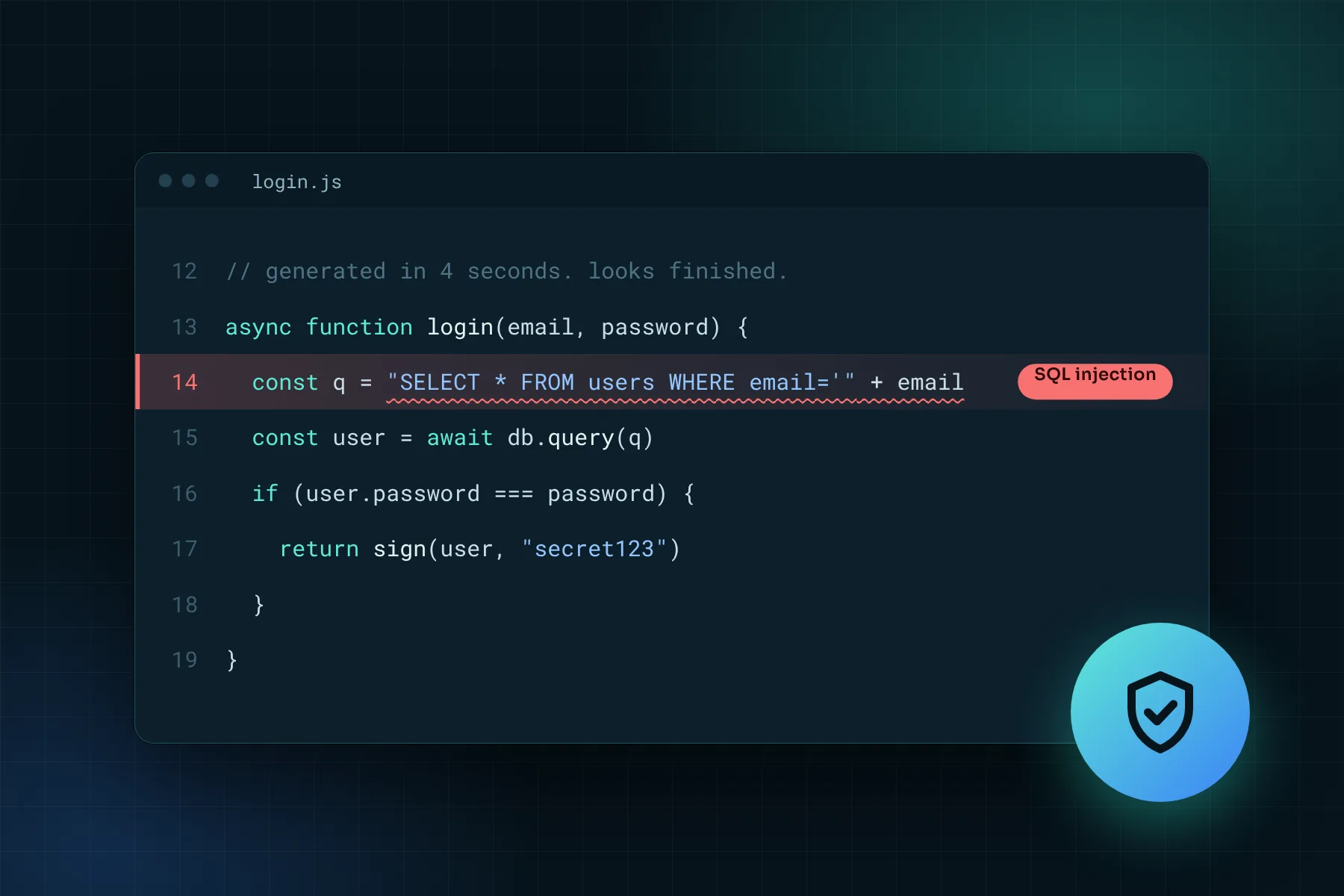
An AI assistant will happily generate a login flow, a database query, or a file upload that looks finished and sails through a demo, all while quietly skipping the checks that keep it from getting exploited in production. The gap between "it works" and "it's safe" is what this guide is about. If you built an MVP by vibe coding, this is the step most likely to bite you later, and it's the one that's easiest to skip because the app already "works."
Is AI-generated code safe? Why it's often insecure
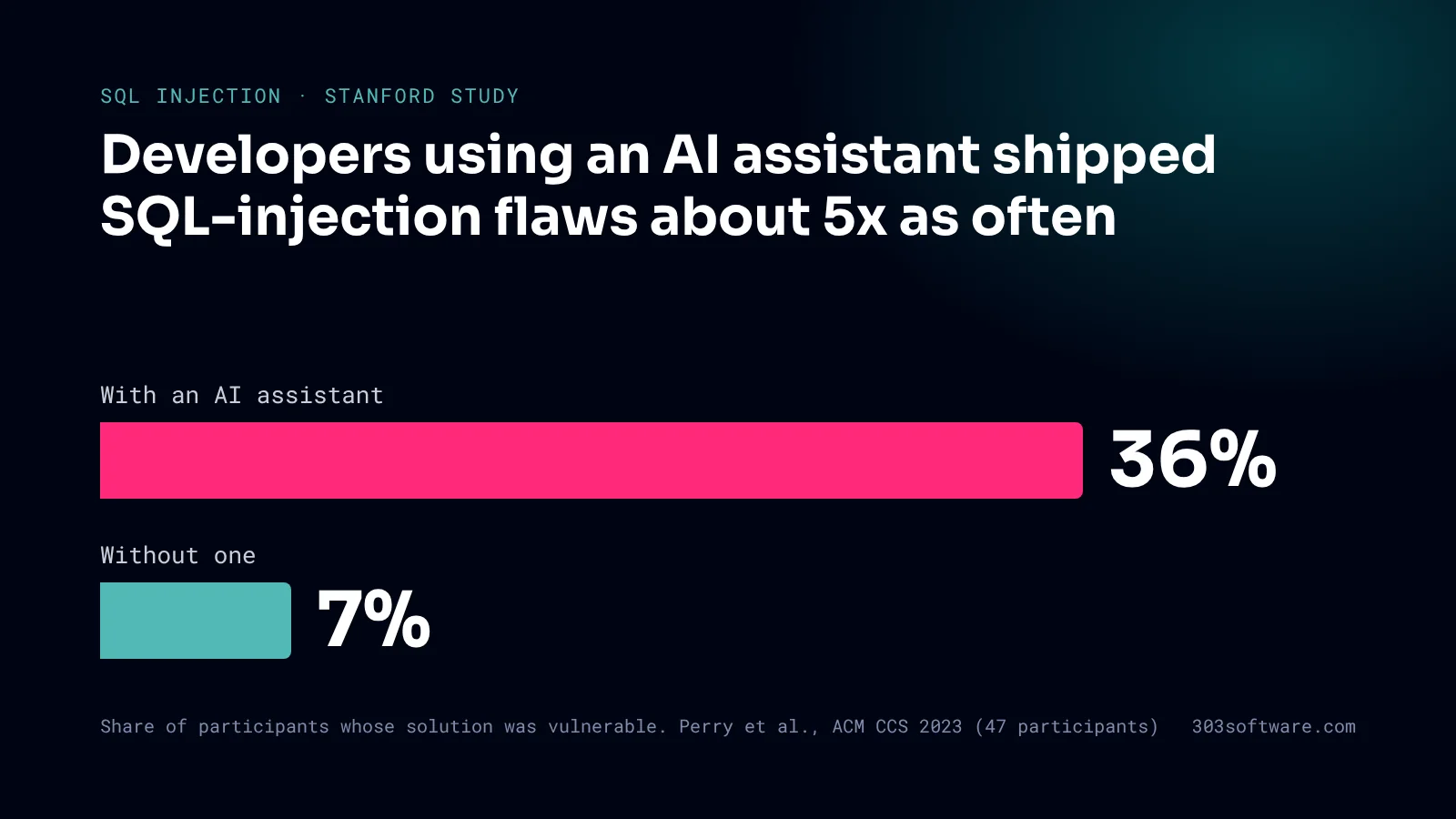
AI-generated code is frequently insecure, and the research is blunt about it. In a controlled Stanford study of 47 participants (ACM CCS 2023), developers with an AI assistant wrote less secure code than those without one, yet were more likely to believe it was secure. Encryption and SQL injection were where they failed worst. That confidence is the dangerous part. The tool makes you feel finished before you are, and feeling finished is not a security review.
The newer numbers back it up, and they come from independent academic testing, not a vendor. Columbia's CWEval benchmark scores code on being functional and secure, and found a notable share of programs that worked but were still vulnerable. ETH Zurich's BaxBench went further: working exploits succeeded against about half of the correct backends that leading models produced, including SQL injection and user impersonation. The code looks better. It isn't safer.
Stop treating "it works" as "it's safe." The OWASP Top 10:2021 is the industry-standard catalog of web application risk, and nearly every common AI coding mistake fits one of its categories. These are the seven we hit most often when a founder hands us a prototype and asks us to make it safe to launch.
The 7 risks and how to fix them
Cheat sheet
7 AI code risks and the fix for each
| # | Risk | OWASP | Fix |
|---|---|---|---|
| 1 | Injection and XSS | A03 | Parameterized queries everywhere. Escape everything you render. |
| 2 | Hardcoded secrets and API keys | n/a | Move secrets to env vars or a secrets manager. Scan for leaks and rotate any key that touched a commit. |
| 3 | Broken or weak authentication | A01A07 | Authorization checks on every endpoint. Hash passwords with bcrypt or argon2. Rate-limit logins. |
| 4 | Insecure or hallucinated dependencies | A06A08 | Verify every package is real and maintained before installing. Run composition analysis. |
| 5 | Missing input validation | n/a | Validate on the server. Whitelist input and enforce types and lengths. |
| 6 | Insecure defaults and misconfiguration | A05 | Debug off in production. Lock CORS to known origins. Change default credentials. Generic error messages. |
| 7 | No security testing or logging | A09 | SAST and DAST in CI. Structured logging with alerts on suspicious activity. |
1. Injection and XSS (OWASP A03)
AI models love to drop user input straight into a SQL query or a chunk of HTML. That's textbook injection. In the Stanford study, 36% of the AI-assisted group produced SQL-injection-vulnerable solutions versus 7% of the control group, and academic security benchmarks consistently find cross-site scripting among the most common failure categories in AI-generated web code.
Fix: Use parameterized queries and prepared statements everywhere, and never string-build a query by hand. Escape or sanitize everything you render to the page, and lean on your framework's built-in templating instead of hand-rolled HTML.
2. Hardcoded secrets and exposed API keys
Ask an AI for a working integration and it'll often paste the API key, database password, or JWT secret right into the source. It runs, so it looks correct. Then it lives in your Git history forever, long after you've forgotten it was there.
Fix: Move every secret into environment variables or a secrets manager. Add a secret-scanning tool to your pipeline, and rotate any key that ever touched a commit.
3. Broken or weak authentication (OWASP A01, A07)
AI writes the happy path. It builds the CRUD endpoint but forgets to check whether the caller is actually allowed to touch that record, and it tends to skip rate limiting and secure password storage entirely.
Fix: Add authorization checks on every endpoint, not just authentication. Confirm passwords are hashed with a modern algorithm like bcrypt or argon2, and put brute-force protection on your login routes.
4. Insecure or hallucinated dependencies (OWASP A06, A08)
This is the one that's genuinely AI-specific. A USENIX Security 2025 study of 576,000 AI-generated code samples found that roughly 20% recommended packages that don't exist. Researchers nicknamed the resulting supply-chain risk "slopsquatting," because attackers can pre-register those predictable fake package names and just wait for someone to install one.
Fix: Verify every package before you install it. Check that it actually exists, is actively maintained, and matches the real project name. Run a software composition analysis tool to flag known-vulnerable versions while you're at it.
5. Missing input validation
AI-generated handlers routinely trust whatever shows up: no length limits, no type checks, no bounds. That's the root cause sitting underneath a lot of the injection and logic bugs above.
Fix: Validate on the server, not just the client. Whitelist acceptable input, enforce types and lengths, and reject anything that doesn't match before it ever reaches your business logic.
6. Insecure defaults and misconfiguration (OWASP A05)
Scaffolded starter apps often ship with debug mode on, permissive CORS, default credentials, and verbose error messages that hand a stack trace to anyone who pokes at them.
Fix: Do a config review before launch. Turn off debug in production, lock CORS to known origins, change every default credential, and make error responses generic to the user while you log the detail privately.
7. No security testing or logging (OWASP A09)
Because the code "works," teams skip the tests. And AI-generated apps frequently ship with no logging or alerting at all, so a breach can sit undetected for weeks.
Fix: Add automated security testing (SAST and DAST) to your CI pipeline, and instrument the app with structured logging and alerts on suspicious activity. If you can't see it, you can't respond to it.
How to audit AI-generated code before shipping
Before an AI-built app goes to production, run it through a short, repeatable audit:
Pre-launch checklist
Audit AI-generated code before you ship
If that list looks like a lot, it is, and it's exactly the work AI tools quietly leave out. Think of it as the difference between a trail that's marked and one that just looks walkable from the parking lot. For a deeper look at what "production-ready" means beyond security, see Is Your AI-Generated Code Production-Ready?
Get your AI-built app hardened
Vibe coding is a genuinely good way to move fast, and we've written before about what it can and can't do. The risk was never building with AI. It's shipping the prototype as production without the hardening step in between.
That's the step 303 Software handles. Our Vibe Check service reviews and secures AI-generated apps, and our AI Integration team builds AI features that are safe from the start. If you built something with AI and you're not sure it's safe to launch, that's exactly the conversation to have.
Frequently asked questions
Is AI-generated code safe to use in production?
Not without review. In a Stanford CCS 2023 study, developers using an AI assistant wrote less secure code than those without one while believing it was more secure. AI code can be made production-safe, but only after a human security review, automated scanning, and dependency verification.
What are the most common vulnerabilities in AI-generated code?
The recurring ones map to the OWASP Top 10: injection and XSS (A03), broken access control and authentication (A01/A07), security misconfiguration (A05), and vulnerable or outdated components (A06). AI also introduces a specific supply-chain risk: hallucinated packages that don't exist.
How common are AI code security risks, really?
Independent academic testing gives a consistent picture: Columbia's 2025 CWEval benchmark found roughly 30 to 36% of functionally correct AI code was still insecure, and ETH Zurich's BaxBench found exploits worked on about half of the correct backends models generated. The exact rate varies by study and model, but the risk is common enough to plan for.
What is slopsquatting?
Slopsquatting is a supply-chain attack that exploits AI package hallucinations. A USENIX Security 2025 study found about 20% of AI-generated code samples suggested non-existent packages. Because the fake names recur predictably, attackers can register them and wait for developers to install malicious code.
How do I secure AI-generated code without a security team?
Start with free, automated tooling: a SAST scanner, secret detection in your pipeline, and software composition analysis for dependencies. Combine that with server-side input validation and parameterized queries. For high-stakes apps, bring in an outside review before launch.
Sources
- Perry, Srivastava, Kumar, Boneh, "Do Users Write More Insecure Code with AI Assistants?" ACM CCS 2023. dl.acm.org/doi/10.1145/3576915.3623157
- Peng et al., "CWEval: Outcome-driven Evaluation on Functionality and Security of LLM Code Generation," LLM4Code 2025. ieeexplore.ieee.org/document/11028476
- Vero et al., "BaxBench: Can LLMs Generate Correct and Secure Backends?" ICML 2025. proceedings.mlr.press/v267/vero25a.html
- Spracklen et al., package-hallucination ("slopsquatting") study, USENIX Security 2025. usenix.org/conference/usenixsecurity25/presentation/spracklen
- OWASP Top 10:2021. owasp.org/Top10/2021
Related posts


Ready to Transform Your Business?
Contact us today to discuss how we can help with your next project or service.