
Your old software isn't free. Here's what it's really costing you.

TL;DR
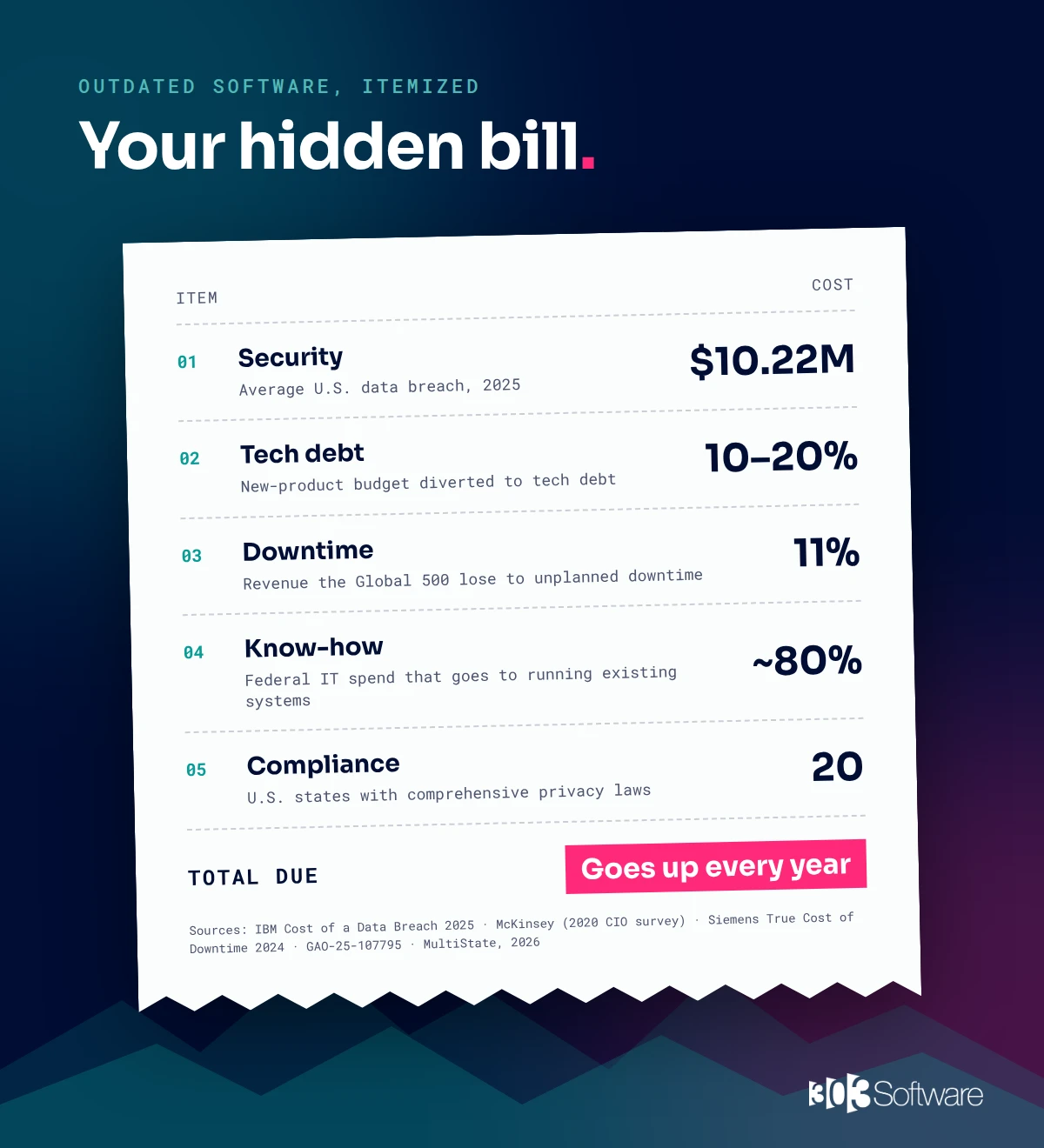
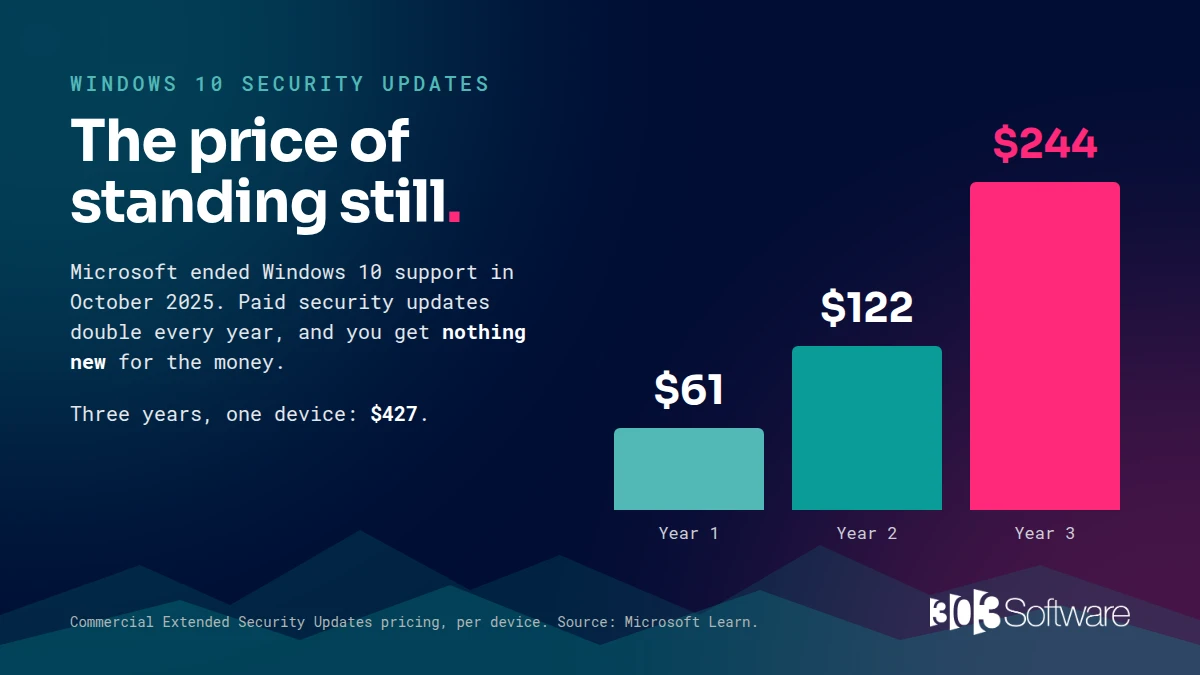
Outdated software keeps billing you through security holes, wasted hours, downtime, lost know-how, and compliance gaps. The stakes are real: the average U.S. data breach hit a record $10.22 million in 2025, and exploited vulnerabilities were the way in for 20% of breaches. Standing still gets pricier every year. Windows 10 security updates double annually, from $61 to $122 to $244 per device. Not every old system needs a rebuild. Sort each one into keep, modernize, rebuild, or retire, and fix the riskiest first.



We get why it's tempting. The system is paid for. Your team knows its quirks. A rebuild sounds like a big check and six months of headaches. So you keep it running, and it keeps quietly billing you in ways that never show up as a line item.
Here's what that bill actually looks like in 2026, with real numbers, and a simple way to figure out what to do about it.
Staying put gets more expensive every year
Want a clean example of how the cost of standing still works? Look at Windows 10.
Microsoft ended Windows 10 support on October 14, 2025. If your business wants to keep getting security patches, you pay for Extended Security Updates. Year one costs $61 per device. Year two costs $122. Year three costs $244. And you can't skip ahead; buying year two means paying for year one too.
That's the pattern with almost every aging system. The price of keeping it alive doesn't hold steady. It climbs, and you get nothing new for the money. Just the privilege of not falling further behind.
Most of your older business software doesn't come with a price tag that honest. Its costs are spread across your security budget, your team's calendars, and your worst days. Let's break them down.
1. You're paying a security tax
Old software is easier to break into. Not because hackers are geniuses, but because the holes are known and nobody's patching them anymore.
The numbers are ugly:
- Exploited vulnerabilities are a growing front door. Verizon's 2025 Data Breach Investigations Report found that exploiting vulnerabilities was the way in for 20% of breaches, up 34% from the year before. Of the vulnerable edge devices and VPNs they tracked, only about 54% were fully fixed during the year, and those fixes took a median of 32 days.
- Small businesses get hit hardest by ransomware. In that same report, ransomware showed up in 88% of breaches at small and mid-sized businesses.
- A breach costs more here than anywhere. IBM's 2025 Cost of a Data Breach Report put the global average at $4.44 million. In the U.S., it hit a record $10.22 million.
Zoom out and it gets bigger. Cybersecurity Ventures estimates cybercrime will cost the world $10.5 trillion in 2025, climbing to $12.2 trillion a year by 2031. Those are projections, not audited totals, but the direction isn't in question.
If your software can't take modern security updates, you're not saving money. You're self-insuring against a very expensive risk.
2. Your team pays in hours and workarounds
This one hides best because it looks like normal work.
It's the spreadsheet someone exports every Monday because two systems won't talk to each other. It's the report that takes a full afternoon because the old database chokes on anything bigger than a year of data. It's the new hire who needs three weeks to learn the "tricks."
Engineers call this technical debt, and it's real money. When McKinsey surveyed CIOs, they estimated tech debt at 20 to 40% of the value of their entire technology estate. They also said 10 to 20% of the budget meant for new products gets diverted to dealing with it.
Put another way: some of the money you set aside to grow is being spent keeping the old stuff upright.
3. Downtime shows up at the worst possible moment
Old systems don't usually die quietly on a slow Tuesday. They buckle under pressure, which means peak season, a big launch, or the week everyone's traveling.
Southwest Airlines learned this the hard way over the 2022 holidays. A winter storm hit, and the airline's aging crew-scheduling technology couldn't keep up with the reshuffling. Nearly 17,000 flights were canceled and more than 2 million travelers were stranded. The meltdown cost Southwest more than $1 billion, and the Department of Transportation followed up with a record $140 million penalty.
You're probably not running an airline. But the math scales down. Siemens' True Cost of Downtime 2024 report found unplanned downtime costs the world's 500 biggest companies about 11% of revenue, roughly $1.4 trillion a year. For a smaller business, even one bad day offline adds up fast: missed orders, idle staff, and customers who quietly go somewhere else.
4. The people who understand it are leaving
Every legacy system has a person. The one who built it, or the one who's been patching it since 2011. When they retire or move on, a lot of how the system actually works goes with them.
Even the federal government is stuck here. A 2025 GAO report found agencies spend over $100 billion a year on IT, and about 80% of that typically goes to operating and maintaining what they already have. Some of their most critical systems are 23 to 60 years old, run on languages like COBOL, and depend on a shrinking pool of people who can still work on them. Seven of the 11 systems GAO flagged had known cybersecurity vulnerabilities.
If you've ever heard "don't touch that, only Dave knows how it works," you already have this problem.
5. The compliance ground keeps moving
Privacy rules don't wait for your software to catch up. In 2023, the big names were GDPR and California's CCPA. Now 20 U.S. states have comprehensive privacy laws on the books, with Indiana, Kentucky, and Rhode Island joining in 2026.
Each new law brings its own rules on what data you store, how you protect it, and how fast you delete it when someone asks. Older systems often weren't built to track any of that. Bolting it on after the fact is slow and expensive, and getting it wrong can mean fines on top of a breach.
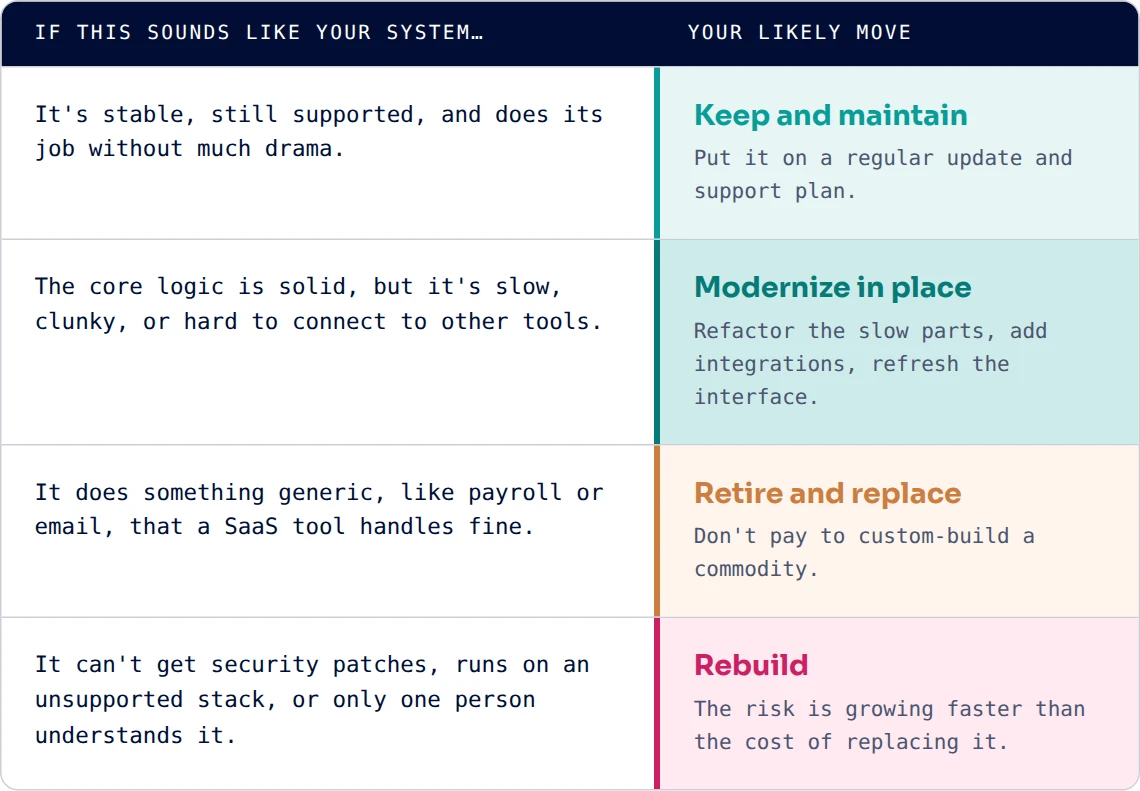
Rebuild, refactor, or retire? A quick gut check
Here's the good news. Not every old system needs a full rebuild. Sometimes the smart move is a tune-up. Sometimes it's pulling the plug and buying something off the shelf.
Use this as a starting point:
What modernization looks like when it's done right
Modernizing doesn't have to mean starting from scratch.
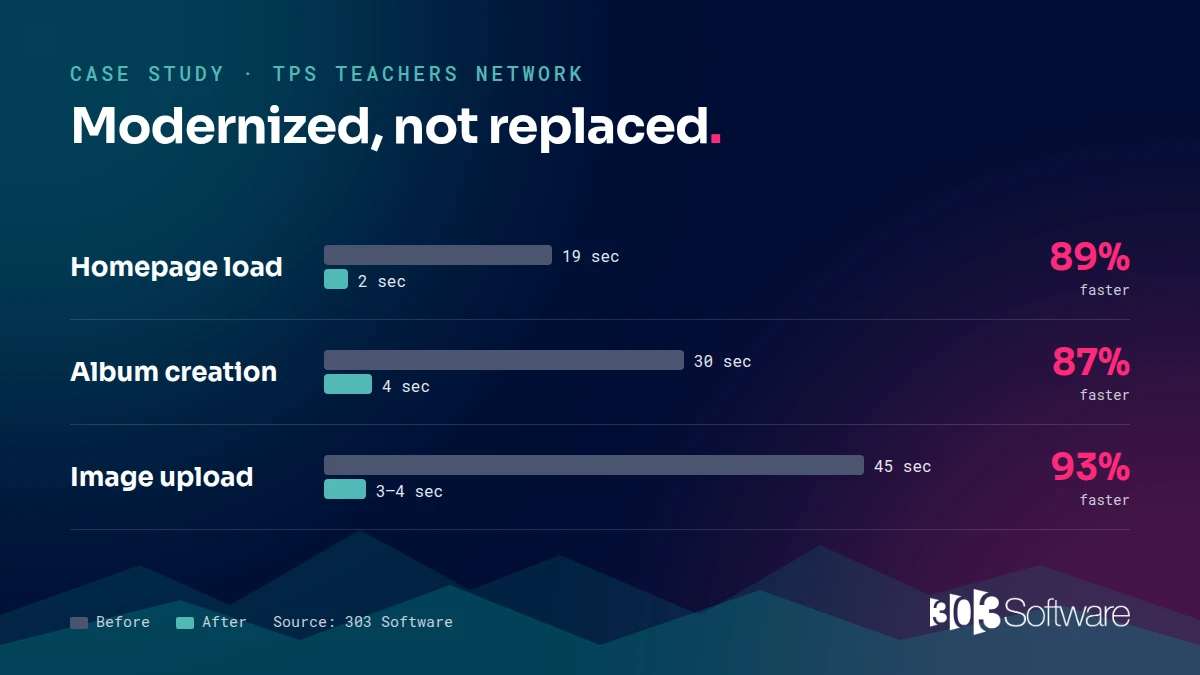
When the TPS Teachers Network came to us, their platform was running on early-2000s technology. Homepage loads took 19 seconds. Image uploads took 45. Teachers were waiting on the tool instead of using it.
Instead of tossing everything and migrating to a new platform, we modernized the system they already had. That kept years of educational content intact and kept the workflow familiar for longtime users. The results: homepage loads dropped from 19 seconds to 2. Image uploads went from 45 seconds to 3 or 4.
That's the goal. Keep what's working, fix what isn't, and stop paying the hidden bill.
Your next step
You don't need to decide today whether to rebuild anything. You just need an honest look at what your current systems are costing you.
That's where we come in. 303 Software has been building and rescuing custom software in Denver since 2006. Our System Design & Planning work maps out what to keep, fix, or replace. If you need ongoing senior guidance without a full-time hire, a Fractional CTO can own the roadmap. And once things are running smoothly, Maintenance & Support keeps them that way.
Schedule a 15-minute call and we'll help you figure out which of your systems are quietly running up the tab.
Frequently asked questions
What is legacy software?
Legacy software is any system that's still in use but built on outdated technology, often no longer supported by its vendor or hard to update, secure, or connect to newer tools. Age alone doesn't make it legacy. A 10-year-old system that's well maintained can be fine, while a 3-year-old one on an abandoned framework can already be a problem.
Why is outdated software a security threat?
Once a vendor stops releasing security patches, every newly discovered flaw stays open. Attackers actively scan for those known holes. Verizon's 2025 DBIR found vulnerability exploitation was the entry point for 20% of breaches, up 34% year over year.
How do I know if my software is outdated?
Common signs: the vendor no longer issues updates, it won't run on current operating systems, it can't integrate with the tools your team uses now, it's getting slower as your data grows, or only one or two people know how to maintain it.
Is it cheaper to maintain old software or replace it?
It depends on the system. Maintaining is cheaper in the short term, but costs usually climb every year through security risk, workarounds, and downtime. If a system can't be patched or is blocking new work, replacing or rebuilding usually ends up cheaper over the long run.
How do you modernize legacy software?
Start with an audit of what each system does and what it costs you. Then sort systems into keep, modernize in place, rebuild, or retire. Many systems can be modernized in stages, fixing the slowest or riskiest parts first, instead of being replaced all at once.
Related posts


Ready to Transform Your Business?
Contact us today to discuss how we can help with your next project or service.