
Is Your AI-Generated Code Production-Ready? A Founder’s Checklist

TL;DR
AI-generated code usually isn’t production-ready out of the box: it runs and demos well, but that’s a much lower bar than being secure, scalable, and maintainable for real users. This checklist covers the seven things to pressure-test before you ship, and if you’re not sure where your app stands, that’s your cue to get a second set of eyes.



"Production-shaped" isn't production-ready
Usually, no. Not without some work first. AI-generated code is often production-shaped: it runs, and looks finished. But "runs on my laptop" and "safe to put in front of paying customers" are two very different bars, and the gap between them is where founders get hurt. This checklist is how you figure out which side of that line your app is on.
None of this is an argument against building with AI. Speed is the whole point of a prototype, and getting to a working demo in a weekend is a real advantage. The mistake is shipping that demo as your production system without hardening it first.
What "production-ready" actually means
Production-ready is not a feeling. It's a set of conditions your app has to meet before real users, real data, and real money depend on it.
At minimum, production-ready code is secure against common attacks, holds up when more than a handful of people use it at once, fails gracefully instead of crashing, has tests that catch regressions, can be maintained by someone who didn't write it, and uses dependencies you can actually trust. A prototype has to do exactly one thing: prove the idea works. That's why AI tools are so good at prototypes and so easy to over-trust for production. The tool optimizes for the demo, not for the 2 a.m. incident. If you're still deciding whether your MVP even belongs in production yet, it's worth revisiting what vibe coding actually is and what it's built to do.
The founder's production-readiness checklist
Walk your app against each item. You don't need to be technical to ask these questions. You need to insist on real answers.
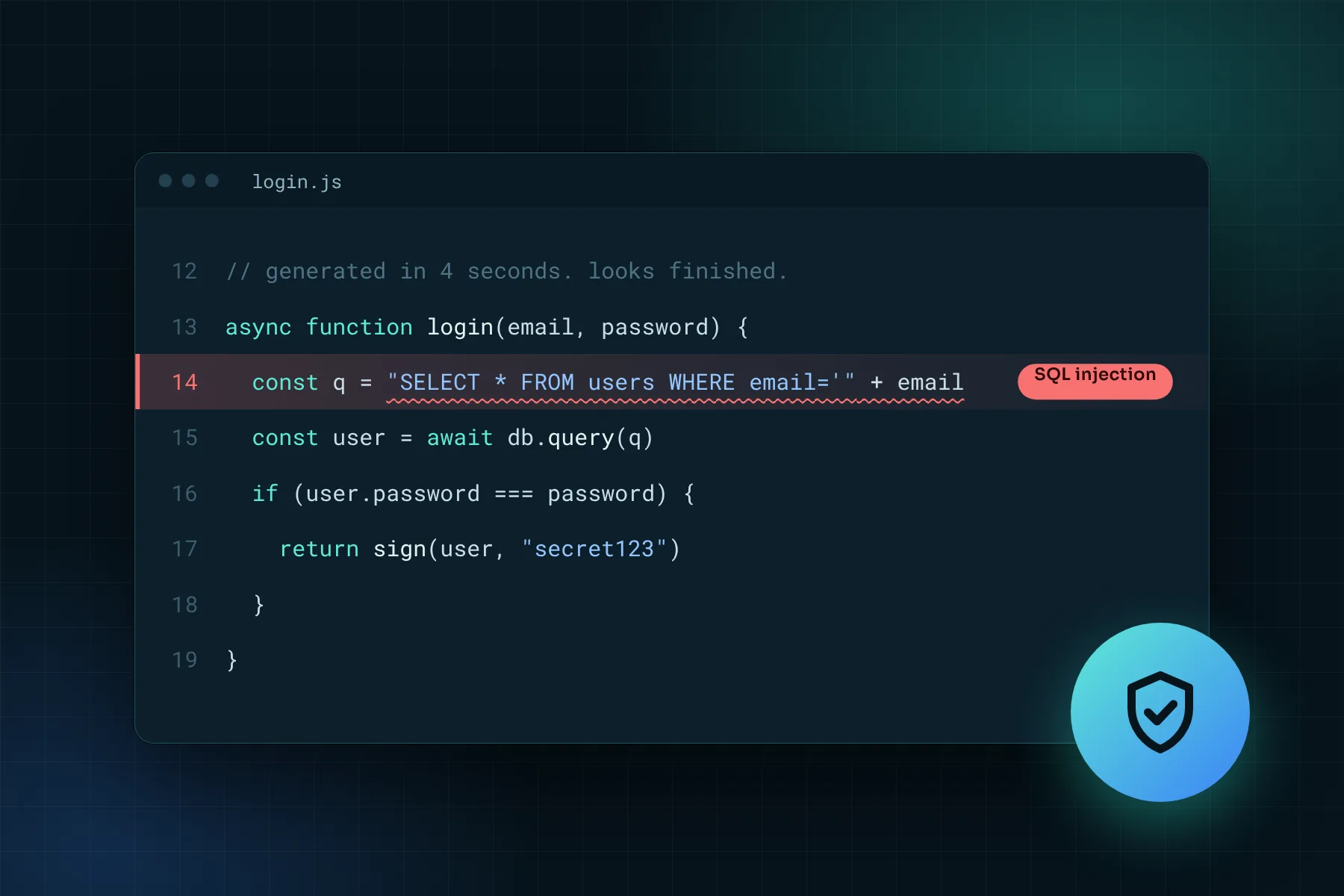
- Security. Has anyone actually reviewed the code for vulnerabilities, or does it just work? This is the big one. When NYU researchers put GitHub Copilot through a battery of security-sensitive scenarios (peer-reviewed at IEEE Security & Privacy, 2022), roughly 40% of the programs it generated came back with vulnerabilities. Newer studies say the same about today's models: in ETH Zurich's 2025 BaxBench, exploits landed on about half of the functionally correct backends the models produced. So treat "the AI wrote it" as the start of a security review, not the end. For what that review should cover, see how to secure AI-generated code.
- Scalability. Will it survive success? Prototypes get built for one user: you, clicking through the happy path. Ask whether the database queries, the hosting setup, and the architecture can handle a hundred concurrent users, or a thousand, without falling over or getting expensive fast.
- Error handling. What happens when something goes wrong, like a payment fails, an upload times out, or an API is down? Production apps expect failure and handle it. AI-generated code tends to write the "everything works" path and skip the messy edges, which is exactly where users lose data and trust.
- Automated tests. If you change one thing, how do you know you didn't break three others? Without automated tests, every edit is a gamble, and the gamble gets worse as the codebase grows. Ask what test coverage exists. "None" is a common and honest answer for vibe-coded MVPs, and a clear signal of work to do.
- Maintainability. Can a developer who didn't build this understand and safely change it? This is where AI-generated code quietly runs up debt. A 2026 study of more than 300,000 AI-authored commits across thousands of open-source projects (independent academic work, still a preprint) found that about a quarter of the problems AI introduced were never cleaned up, and security issues stuck around the most. Duplicated, boilerplate-heavy code is genuinely harder and pricier to maintain, and it compounds with every feature you add.
- Dependency and hallucinated-package risk. Do you know that every library your app imports actually exists and is safe? AI tools sometimes invent packages that were never real. A USENIX Security 2025 study of 576,000 AI-generated code samples found that roughly 20% of them recommended non-existent packages, a rate that varies by model (commercial models like GPT-4 hallucinated around 5%, open-source models far more). Attackers have learned to register those made-up names with malware, an attack pattern nicknamed "slopsquatting." Every dependency needs to be verified, not assumed.
- Documentation. If you got hit by a bus tomorrow, could someone else run this? Even a plain-language README covering how it's set up, deployed, and configured turns a black box into a system a team can own.
What typically breaks when vibe-coded apps hit production
The failures are predictable, which is the good news. Predictable means preventable. Security holes surface first: an exposed API key, a form that lets someone read another user's data, an endpoint with no authorization check. Then come the scale problems, like an app that was snappy for one user grinding to a halt, or a cloud bill that balloons because nothing was optimized. Data issues follow close behind, when unhandled errors let a failed operation corrupt or lose records. And underneath all of it sits maintainability debt: the AI-introduced issues that never get cleaned up make the next fix slower and riskier than the last. There's a reason experienced teams treat "it works in the demo" as the beginning of the engineering, not the end, a point we dug into in Can Vibe Coding Really Make You an App Developer?
How to check if code is AI-generated
There's no perfectly reliable detector, so treat this as reading signals, not proof. The tells: uniform, textbook-style formatting and comments throughout; verbose "explains-the-obvious" comments on trivial lines; generic variable and function names with no house style; large blocks of near-duplicate logic instead of reused functions; and imports for packages that don't exist or that nobody on the team recognizes. Honestly, for a founder the more useful question isn't "was this written by AI." It's "is this code safe and maintainable," which the checklist above answers directly regardless of who or what typed it.
Get a straight answer: 303's Vibe Check
If you've read this far and you're not sure how your app scores, that uncertainty is the answer: you need a second set of eyes. 303 Software has built and hardened custom software since 2006, and our Vibe Check is a focused review of your AI-generated or vibe-coded app. We tell you where it's genuinely production-ready, where it isn't, and what it takes to close the gap. You keep the speed you got from building with AI. We make sure it holds up when real users show up.
Frequently asked questions
Is AI-generated code safe to use in production?
It can be, but not as-is. AI-generated code frequently ships with security and reliability gaps. Peer-reviewed research has found roughly 40% of AI-generated code in security-sensitive scenarios contained vulnerabilities, so it needs human security review, tests, and hardening before it carries real users and data.
Is AI-generated code production-ready out of the box?
Rarely. AI tools optimize for a working demo, not for the security, scale, error handling, and maintainability that production demands. The code often runs fine while missing the safeguards a live app needs, which is why a checklist review matters before launch.
What breaks first when a vibe-coded app hits production?
Usually security and scale. Exposed keys, missing authorization checks, and unhandled errors surface early, followed by performance problems as usage grows. Maintainability debt, like duplicated, copy-pasted code, then makes each subsequent fix slower and riskier.
Can you scale an app built with AI or vibe-coding tools?
Often yes, but the prototype architecture usually has to be reviewed and reworked first. Prototypes are built for one user on the happy path; scaling to many concurrent users typically means revisiting the database, hosting, and structure before growth exposes the limits.
How can I tell if code was written by AI?
Look for signals, not proof: uniform textbook formatting, over-explained comments on trivial lines, generic naming, large near-duplicate blocks, and imports for packages that don't exist. No detector is reliable, so the more useful question is whether the code is secure and maintainable.
What is slopsquatting and should founders worry about it?
Slopsquatting is when attackers register the fake package names AI tools hallucinate, then load them with malware. A USENIX Security 2025 study found about 20% of AI-generated samples referenced non-existent packages, so every dependency in your app should be verified as real and safe.
Sources
- Pearce et al., "Asleep at the Keyboard? Assessing the Security of GitHub Copilot's Code Contributions," IEEE S&P 2022. ieeexplore.ieee.org/document/9833571
- Vero et al., "BaxBench: Can LLMs Generate Correct and Secure Backends?" ICML 2025. sri.inf.ethz.ch/publications/vero2025baxbench
- Liu et al., "Debt Behind the AI Boom: A Large-Scale Empirical Study of AI-Generated Code in the Wild," 2026 (preprint). arxiv.org/abs/2603.28592
- Spracklen et al., package-hallucination ("slopsquatting") study, USENIX Security 2025. usenix.org/conference/usenixsecurity25/presentation/spracklen
Related posts

Ready to Transform Your Business?
Contact us today to discuss how we can help with your next project or service.